

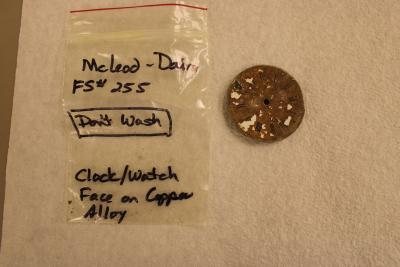
Charleston County Parks has spent decades uncovering pieces of the Lowcountry’s past. When the agency acquires a new property, one of the first steps is an archaeological phase one survey to better understand who lived on the site, what happened there and what stories the land may still hold. From fragments of pottery and glass to buttons, bricks, bullet fragments and even pieces of a child’s doll or a watch face, those discoveries have built a growing collection of objects and artifacts tied directly to Charleston County’s history.
For years, however, those collections lived scattered across the Southeast. Artifacts recovered during archaeological surveys were housed in five different locations across South Carolina and Georgia, often remaining with the archaeological firms that conducted the work or other museums that offered storage. As Charleston County Parks continued to grow its park system and preserve more land, the collection itself became harder to fully interpret.
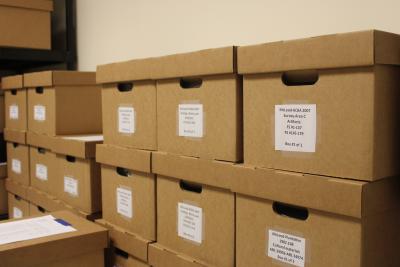
Now, for the first time, all of Charleston County Parks’ archaeological collections are housed together under one roof at the Warren Lasch Conservation Center in North Charleston. The move marks a milestone for the agency and creates a new opportunity to better preserve, document and eventually interpret these artifacts for the public.
“We’re looking at our collections from point A and sorting, collecting, and recording so that we as an agency can then disseminate that information to our interpretive staff or to other institutions,” Charleston County Parks Land Resource Planner Adam Ronan said.
 Inside the collections space, every item is carefully processed and cataloged. With the help of staff at the Warren Lasch Conservation Center, artifacts are being meticulously labeled and boxed according to professional museum and conservation standards. The work is detailed and methodical, but it creates the foundation for understanding the full scope of the agency’s archaeological collection.
The effort gained momentum in 2022 when Charleston County Parks updated and consolidated its collections management plan into a single guiding document, bringing everything together created a roadmap for preservation, documentation and future interpretation. The updated plan also reaffirmed the agency’s commitment to professional stewardship and collections care.
“That was a huge stepping stone to where we are now with all of our collections in one place,” Ronan said.
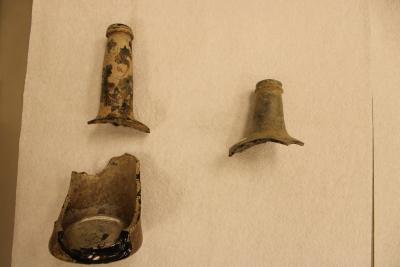
The agency has also already begun working with the Warren Lasch Conservation Center to prepare select pieces for future public display. Four items have undergone conservation treatment so far, including two bells and a historic sign that will eventually be displayed at Old Towne Creek County Park, along with a sign formerly displayed at McLeod Plantation Historic Site.
Conservation work helps stabilize and preserve objects while ensuring they can be accurately interpreted for visitors in the future.
“The goal is to first study and analyze our collections here at Warren Lasch, and then decide which objects we should conserve to then display to the public,” Ronan said.
Several Charleston County Parks staff members have already visited the collections to begin exploring what stories might emerge from the artifacts now gathered together in one place. Those discoveries could eventually shape future exhibits, signage and programming at different parks.
At the same time, archaeological work across Charleston County Parks properties continues.
“Right now, the epicenter of our archeological efforts is at our Wallace Creek property, the old Sea Island Farmers Cooperative. The University Of North Carolina is also working with us through an archeological grant to learn more about the Stono Rebellion and how that ties into the story of the Caw Caw Interpretive Center,” Ronan said.
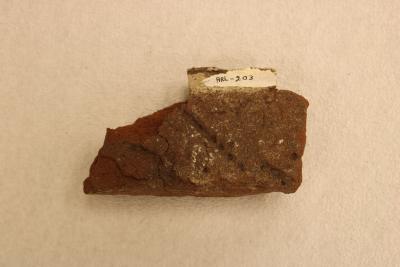
For Charleston County Parks, the work happening now is about far more than storage. It is about creating access, context and understanding for future generations. The artifacts may be small in size, but together they help tell the larger story of the people who shaped the Lowcountry long before these places became parks.
“We don't have a lot of these answers yet, but we can start to get them now that everything is in one place,” Ronan said.